


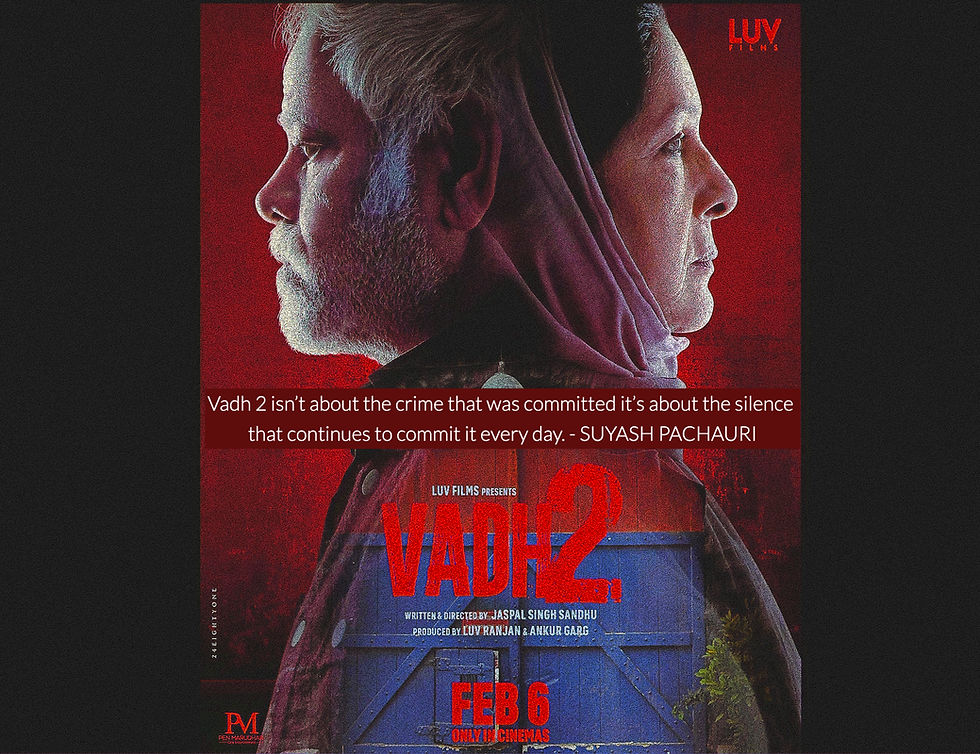
FILM REVIEW: "VADH 2" Vadh 2 isn’t about the crime that was committed it’s about the silence that continues to commit it every day.
- Suyash Pachauri
- Feb 5
- 6 min read
Introduction
Vadh 2 arrives with the heavy burden of legacy. The first Vadh surprised audiences with its grounded tension, morally complex characters, and a slow-burning narrative that focused more on human psychology than sensational crime. A sequel, therefore, was always going to be risky especially when the original film’s impact came from its restraint, realism and emotional discomfort rather than commercial spectacle.
Fortunately, Vadh 2 does not attempt to become louder, flashier or artificially “bigger” than its predecessor. Instead, it chooses a darker and more introspective route. The film expands the thematic universe of the original while introducing a fresh central conflict that deals with guilt, social silence, institutional failure and the invisible scars of violence. Rather than repeating the same plot mechanics, the makers use the sequel as an emotional continuation of a moral question what happens after a crime when life refuses to return to normal?
Set in a familiar middle-class urban environment, Vadh 2 unfolds like a slow, suffocating pressure chamber. The film is less about discovering who committed the crime and more about understanding why people keep committing small betrayals every day towards family, society and even their own conscience. The story deliberately avoids sensational twists and instead builds unease through everyday moments, hesitant silences and uncomfortable conversations.
What makes Vadh 2 immediately engaging is its refusal to spoon-feed the audience. It demands patience. It asks viewers to sit inside moral ambiguity. And most importantly, it resists the modern trend of turning crime dramas into stylish thrill rides. This is a film that wants to disturb, not entertain easily.
Screenplay & Script Sense
The screenplay of Vadh 2 is its strongest and most quietly powerful weapon. Written with remarkable control, the script understands that real tension is not created by chase sequences or loud confrontations, but by emotional contradiction. The writing places its characters in situations where no choice feels entirely correct.
Structurally, the screenplay unfolds in carefully layered chapters. The opening act sets the emotional tone rather than the narrative hook. We are introduced to the protagonist’s fragile mental state and the lingering shadows of a past crime. Instead of rushing into a new incident, the film allows the audience to reconnect with the psychological residue of violence fear, paranoia, mistrust and denial.
The second act introduces a new social conflict that appears deceptively simple but gradually reveals multiple moral fault lines. The script is intelligent in the way it presents opposing perspectives without overtly labeling anyone as villain or hero. The dialogue is restrained, almost minimalistic, and never tries to sound “filmy.” Conversations feel organic, sometimes painfully incomplete, reflecting how people in real life avoid direct confrontation.
One of the most impressive aspects of the script is its emotional continuity. The film never treats the events of the first part as a marketing gimmick. Instead, it treats them as emotional baggage carried by the characters. Subtle references through behaviour, hesitation and visual memory make the narrative feel lived-in rather than constructed.
However, the screenplay is not without flaws. The mid-section slightly overstretches certain emotional beats. A few scenes linger longer than necessary, repeating the same emotional note without adding new layers. While this slow pace may work for viewers who appreciate meditative storytelling, it might test the patience of those expecting a conventional thriller rhythm.
Still, the script’s sincerity, psychological realism and ethical depth elevate Vadh 2 above most contemporary crime sequels.
Direction
The direction in Vadh 2 is remarkably restrained and mature. The director shows immense confidence by refusing to manipulate the audience emotionally. There are no dramatic camera movements, no background music cues forcing us to feel something, and no exaggerated visual metaphors.
Instead, the director allows silence to breathe.
Scenes are staged with natural blocking and realistic spatial awareness. Characters often occupy different parts of the frame, visually reinforcing emotional distance and internal isolation. The director repeatedly uses everyday locations living rooms, narrow streets, small offices and hospital corridors to highlight how tragedy quietly coexists with routine life.
One of the film’s greatest achievements lies in its observational style. The director frequently chooses to let scenes play out in extended takes, allowing discomfort to settle in. There is a deep respect for actors’ performances, with the camera rarely interrupting emotional moments through unnecessary cuts.
The emotional complexity of the narrative is handled with sensitivity. There is no moral grandstanding. Even in moments where the film comments on social injustice or systemic failure, the director keeps the focus on individual emotional consequences rather than ideological messaging.
However, this minimalist approach may not work for every viewer. The absence of conventional dramatic escalation sometimes makes the film feel emotionally heavy without offering sufficient narrative relief. But within the film’s chosen aesthetic, the direction remains consistent and deeply purposeful.
Acting
The performances in Vadh 2 are uniformly strong and anchored by a central performance that quietly dominates the film.
The lead actor delivers a layered and emotionally restrained portrayal of a man trapped between guilt and survival. His performance is not about emotional outbursts. It is about micro-expressions trembling hands, lingering glances, nervous pauses and subtle physical exhaustion. There is a lived-in quality to his performance that makes the character believable even during morally questionable decisions.
The emotional complexity of the character is handled with admirable restraint. The actor never attempts to justify the character’s actions through melodrama. Instead, he allows contradictions to coexist fear and arrogance, tenderness and emotional detachment, vulnerability and moral compromise.
The female lead offers an equally powerful performance. Her character is written with nuance, and the actor brings quiet strength to a role that could have easily been reduced to a supportive stereotype. Her emotional journey marked by confusion, suppressed anger and reluctant acceptance is one of the film’s emotional pillars.
What stands out most is the natural rhythm between the two central performers. Their interactions feel lived-in rather than staged. There is an emotional history between them that the film never explicitly spells out, yet it is strongly felt through body language and conversational subtext.
Supporting Cast
The supporting cast significantly enriches the emotional texture of Vadh 2. Each secondary character serves a narrative purpose rather than functioning as filler.
A particularly notable performance comes from the actor playing the investigating officer. Instead of presenting a conventional tough cop persona, the character is portrayed as a conflicted professional caught between procedure and personal conscience. His performance adds an important ethical counterpoint to the film’s central conflict.
Another standout is the elderly neighbour, whose seemingly minor presence gradually acquires symbolic importance. The actor captures social indifference and emotional detachment with unsettling authenticity.
Even the smallest roles office colleagues, family members and hospital staff are played with understated realism, helping the film maintain its grounded atmosphere.
Cinematography
The cinematography of Vadh 2 complements the emotional narrative rather than attempting to stylise it. The visual palette is deliberately muted, dominated by earthy tones and soft shadows.
The camera frequently adopts a slightly distant observational perspective, placing the audience in the role of a silent witness. This approach reinforces the film’s central theme of social silence and passive complicity.
Interior spaces are framed with natural light sources windows, lamps and hallway reflections creating a quiet claustrophobia without resorting to artificial lighting gimmicks. Exterior shots, particularly in residential neighbourhoods, are composed with careful attention to background activity, subtly reminding us that life continues indifferently around private tragedy.
The cinematography never seeks visual spectacle. Its power lies in emotional understatement.
Music & Background Score
The music in Vadh 2 is minimalistic and highly controlled. The background score appears sparingly, often entering only after a scene has emotionally concluded.
Instead of guiding emotional responses, the music functions as an atmospheric extension of the characters’ mental state. Low-frequency drones, faint piano notes and ambient textures quietly underline moments of emotional vulnerability.
The absence of a conventional soundtrack works in the film’s favour. Silence frequently becomes more powerful than any musical cue, allowing discomfort to remain unresolved.
Editing
The editing style of Vadh 2 reflects its narrative philosophy slow, deliberate and observational.
The film avoids fast cut montage sequences. Scenes are allowed to unfold organically, preserving natural conversational rhythms and emotional pauses. This approach strengthens character immersion but also slightly slows narrative momentum during the middle stretch.
A few subplots could have benefited from tighter trimming. Some repetitive emotional beats dilute their impact due to overextension. However, the overall narrative coherence remains intact, and the editing successfully preserves the film’s contemplative tone.
Final Verdict
Vadh 2 is not designed to be a crowd-pleasing sequel. It is an emotionally demanding, morally complex and quietly unsettling film that expands the psychological world of the original rather than exploiting its success.
This is a film for viewers who appreciate slow-burn narratives, ethical ambiguity and emotionally grounded storytelling. It refuses to sensationalise violence and instead focuses on the psychological aftermath of crime how it corrodes relationships, distorts perception and isolates individuals within their own homes.
While its pacing may divide audiences, its emotional honesty, powerful performances and restrained direction make Vadh 2 one of the more mature and thoughtful crime dramas in recent times.
On the Plus Side
Strong, emotionally restrained lead performances
Thoughtful and morally layered screenplay
Subtle and confident direction
Realistic portrayal of social silence and emotional aftermath
Minimalistic yet effective background score
Grounded cinematography that supports the narrative
On the Minus Side
Slow pacing in the second act may test audience patience
Certain emotional beats feel slightly repetitive
Limited narrative escalation may disappoint viewers expecting a conventional thriller structure
Some subplots remain underdeveloped
One Liner By Suyash Pachauri
Vadh 2 isn’t about the crime that was committed , it’s about the silence that continues to commit it every day.
![FILM REVIEW: MAA BEHEN [Netflix Film]](https://static.wixstatic.com/media/24b4bc_2a5bd8d9f7f04364b7f3e8aef95528ba~mv2.png/v1/fill/w_980,h_905,al_c,q_90,usm_0.66_1.00_0.01,enc_avif,quality_auto/24b4bc_2a5bd8d9f7f04364b7f3e8aef95528ba~mv2.png)

